


Some children talk non-stop at home and then go silent the moment a teacher asks them to share. Others find it hard to get a word out at all once the spotlight is on them. If either sounds familiar, here’s something worth remembering: confidence is not a personality trait your child either has or doesn’t have. It’s a skill, and skills grow with practice.
The best place to practise isn’t a stage. It’s somewhere your child already feels safe, heard and allowed to be a little bit silly: your dinner table.
Here are five simple games you can play tonight. No preparation, no worksheets, no pressure. Just ten minutes that help your child think on their feet, organise their ideas and get used to the feeling of everyone listening.
1. Two-Minute Talk
Everyone takes a turn talking for up to two minutes on a topic picked from a jar: “the best animal”, “my perfect weekend”, “if I ran the school”. The rule is simple: keep going, even if you go off on a tangent.
Why it works: it builds the “keep talking” muscle that helps children recover when they lose their place in a class talk. For younger or quieter children, start with 30 seconds and celebrate every extra few seconds as they grow.
2. Pass the Story
One person starts a story with a single sentence: “Once upon a time, a penguin found a mysterious key…” The next person adds a sentence, and so on around the table. The sillier, the better.
Why it works: it’s storytelling and quick thinking at the same time, and nobody carries the whole thing alone. It’s a gentle first step for a shy child, because each turn is just one sentence.
3. Sell Me This Spoon
Pick any everyday object on the table, such as a spoon, the salt shaker or a broccoli floret, and challenge your child to convince everyone to “buy” it. What makes it special? Who needs it? Why should we buy it today?
Why it works: it’s persuasion in disguise. Your child practises giving reasons, using an enthusiastic voice and making eye contact, the same skills that help in debating and persuasive writing at school.
4. Rose & Thorn
Each person shares one “rose” (the best part of their day) and one “thorn” (something that was hard). Parents go too, and that matters: when your child hears you talk about a tricky moment, it shows them that sharing struggles is normal.
Why it works: it helps children put feelings into words and speak in front of others about something real, which is the foundation of a confident speaker. It’s also a lovely way to find out what actually happened at school.
5. Silly Debate
Choose a light-hearted topic: “Cats are better than dogs”, “Breakfast is the best meal”, “Kids should choose dinner every Friday”. One person argues for, one argues against, and everyone else votes. Then swap sides.
Why it works: arguing the side you don’t agree with is a brilliant thinking exercise, and it teaches children to listen and respond calmly rather than just repeat their point. It’s a fun first taste of debating.
How to keep it fun (and keep them coming back)
- Keep it short. Ten minutes is plenty. Stop while everyone’s still enjoying it.
- Let them pass. A shy child who knows they can say “pass” is far more likely to have a go next time.
- Praise the brave bit, not the polish. “You kept going even when you got stuck. That was brave” means more than “That was perfect”.
- Join in and be imperfect. When you stumble and laugh it off, your child learns that mistakes are part of speaking up.
- Notice the growth. If your child managed 20 seconds last week and a whole minute this week, tell them. That’s confidence growing.
If your child has a bigger moment coming up, such as a school speech or competition, our guide on how to help your child prepare for a speech competition walks through the week before, step by step.
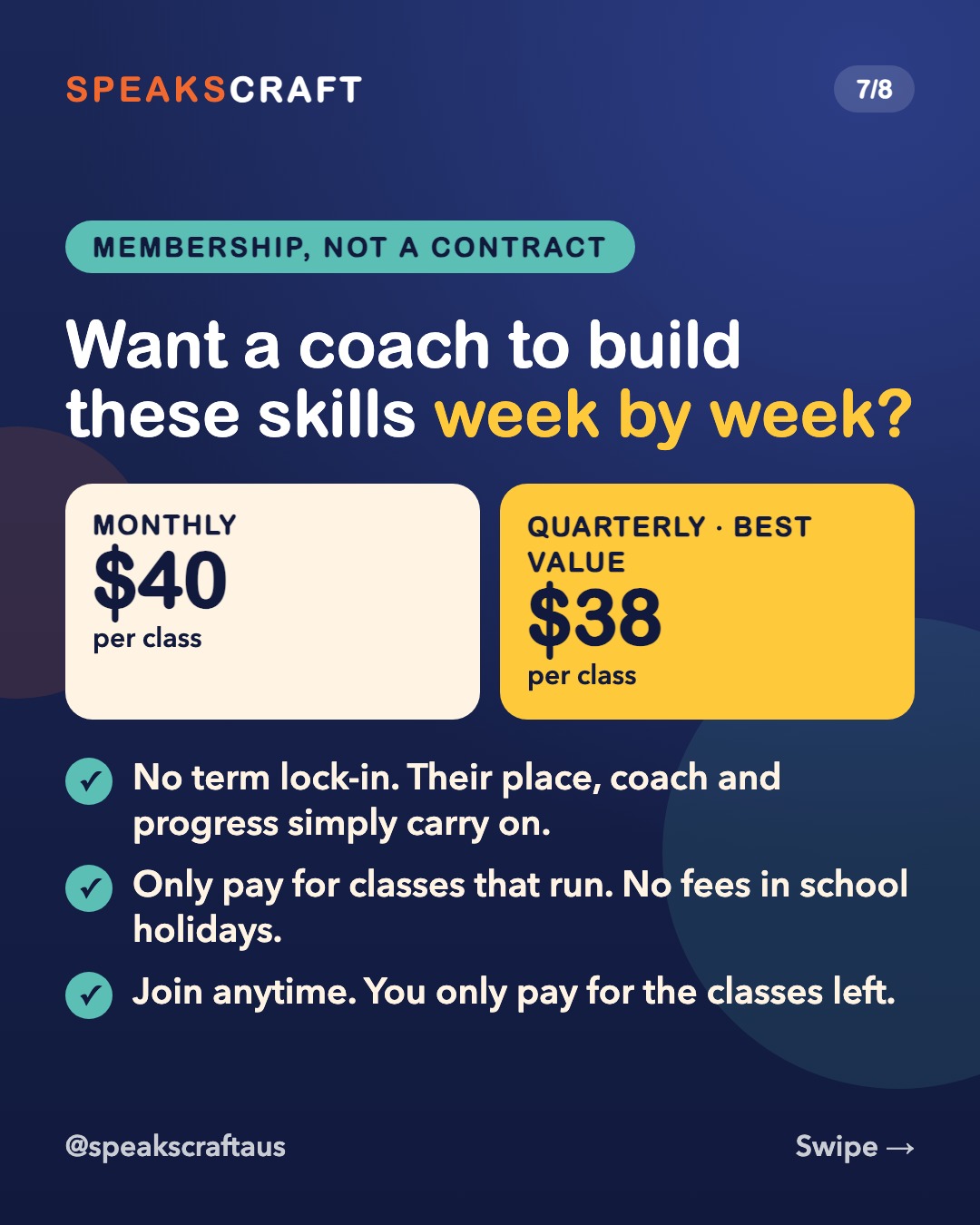
Want a coach to build these skills week by week?
Dinner-table games are a wonderful start. Our weekly classes take the same idea further: a small, supportive group where every child speaks, tries, gets encouraging feedback and tries again.
SpeaksCraft runs small-group classes of 6 to 10 students for children aged 5 to 17, with no experience needed. Across each term our 4-in-1 program covers public speaking, debating, drama and creative writing, and every term finishes with a showcase. Classes run in person across Sydney and in Willetton, Perth (see our Sydney classes), and live online for families anywhere in Australia.
It’s a membership, not a contract:
- Monthly: $40 per class. Quarterly (best value): $38 per class.
- No term lock-in. Your child’s place, coach and progress simply carry on.
- Only pay for classes that run. No classes and no fees in school holidays.
- Join anytime. Starting mid-way? You only pay for the classes left.
Start with a one-off Discovery Class for $45, in person or online. It’s a real, live class, and if you go on to join, the Discovery Class fee comes off your first membership payment.
